
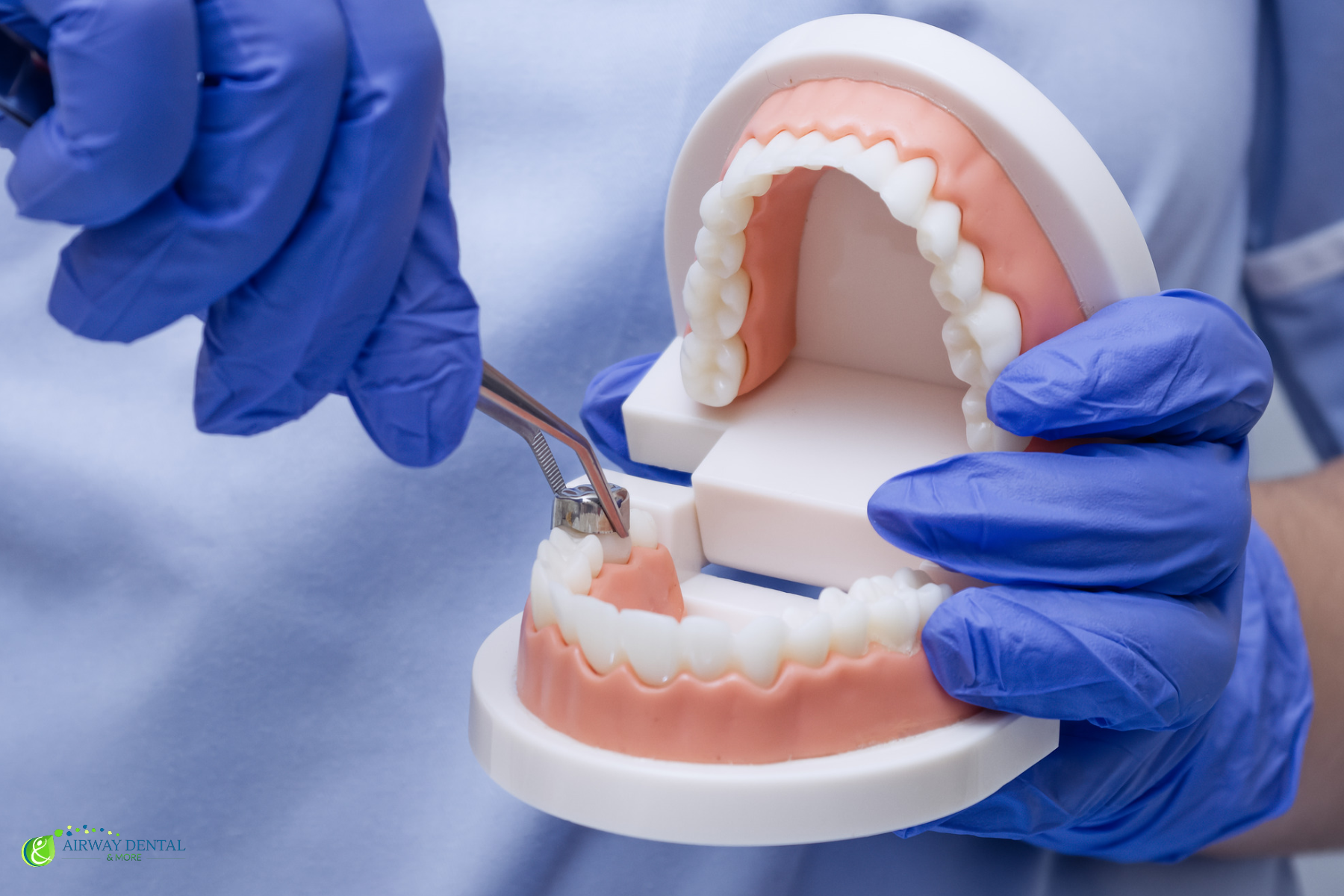
If your dentist discovers a cavity, crack, or damaged area of a tooth, you may hear two common treatment options: a dental filling or a crown.
But why does one tooth need a simple filling while another requires a crown?
The answer depends on several factors, including how much of the tooth is damaged, how much healthy tooth structure remains, and how much pressure the tooth experiences when you chew.
Understanding the difference can help you feel more confident about your dental treatment.
What Does a Dental Filling Do?
A dental filling repairs a damaged or decayed portion of a tooth while preserving as much healthy natural tooth structure as possible.
Tooth-colored composite fillings are commonly used to restore teeth affected by smaller or moderate areas of decay.
According to the American Dental Association, composite materials can provide good durability and fracture resistance for small- to mid-sized fillings, including restorations on back teeth.
At Airway Dental & More, our Restorative Dentistry services include tooth-colored fillings designed to restore the function and appearance of damaged teeth.
When Might a Dental Crown Be Recommended?
A dental crown covers more of the tooth and may be recommended when a tooth has experienced significant structural damage.
Common reasons a dentist might consider a crown include extensive decay, fractures, significant wear, or a large existing filling that has weakened the remaining tooth.
However, not every tooth with a large filling automatically needs a crown.
Your dentist evaluates the condition of the tooth, remaining healthy structure, bite forces, and other factors before recommending treatment.
What Does Recent Dental Research Tell Us?
A large study published online in 2025 examined 343,809 teeth treated with either extensive direct restorations or single dental crowns.
Researchers followed outcomes over five to ten years and found that both treatment approaches demonstrated high levels of long-term tooth survival.
Although crowns showed somewhat higher estimated survival in the study population, the results don't mean that crowns are always the better option. The study was observational, and the teeth receiving each treatment may have differed before treatment.
Research published in the Journal of Dentistry in 2024 examined more than 700,000 tooth-colored fillings placed in back teeth at 99 general dental practices across the United States.
Researchers found that these fillings had a median lifespan of approximately 13 years. Larger fillings that covered more of the tooth generally didn't last as long as smaller ones.
This research highlights why your dentist considers both the size of the damaged area and the amount of healthy tooth remaining when recommending a filling or dental crown.
Why Preserving Healthy Tooth Structure Matters
One of the goals of modern restorative dentistry is to preserve healthy natural tooth structure whenever clinically appropriate.
A filling may be suitable when enough healthy tooth remains to support the restoration.
A crown may be considered when additional coverage is needed to protect a tooth with more extensive damage.
Neither treatment is automatically the best choice for every situation. A thorough dental examination helps determine which option is most appropriate for your needs.